
Liquid Flowing Screed FAQs

Your Questions Answered
Does liquid screed guarantee a flat finish?
We guarantee that your liquid-flowing screed floor will be levelled to an SR2 standard. This equates to no deviation more significant than 5mm across a 2m area, in accordance with BS8203.
How shallow can a liquid-flowing screed be installed?
Where the screed is separated from the concrete subbase with a polythene membrane (DPM), it can be laid to a minimum of 15mm thick. As a floating screed, when laid directly on top of the insulation, it can be laid to a minimum of 35mm domestic and 40mm commercial.
How skilled do I need to be to install liquid screed?
Due to the fast-drying nature of liquid-flowing screeds once placed, rectifying mistakes retrospectively is challenging. We recommend that liquid-flowing screeds be laid only by specialist contractors.
How quickly can I walk on liquid screed?
Foot traffic on liquid-flowing screeds usually is within 24-48 hours.
What is the drying time for liquid screed? When can I apply finishes?
You can only lay a floor finish on top of a thoroughly dried screed floor, typically 75RH; otherwise, the moisture released during the drying process will cause the finished floor surface to de-bond. For estimated drying times, please see the table below:
Depth | Drying Time |
O – 40mm Depth | 1 Day per mm depth |
>40mm Depth | A further two days per mm depth above 40mm |
This is contingent on a temperature of 20 degrees and a 65% relative humidity.
The first 24-48 hours are the most important, and we recommend that doors and windows remain firmly closed and the floor be left untouched. After 48 hours, the floor should be dry enough to walk on; however, each area should be checked before foot traffic, and heavy foot traffic should be avoided.
After 48 hours, doors and windows should be left open to accelerate the drying process, but please avoid water ingress from inclement weather.
Can the drying process of my liquid-flowing screed be accelerated?
After the liquid screed has dried naturally for seven days, you can accelerate the drying process for most liquid-flowing screeds; however, manufacturers’ recommendations must be followed for each screed type.
If you lay a liquid-flowing screed on top of underfloor heating, you can use the underfloor heating system to accelerate the drying process. We recommend a water temperature of 25 degrees Celsius for three days, increasing by 5 degrees Celsius per day to a maximum of 55 degrees Celsius. When reducing the heat for the first time (cycle), do the same process in reverse to avoid thermal shock. Reduce by 5 degrees Celsius daily to 25 degrees Celsius before switching off the underfloor heating.
You can also use dehumidifiers in conjunction with this process to remove moisture from the air.
Can a DPM coating be applied to allow covering to be installed earlier?
Yes, specific DMP coatings are available for liquid-flowing screeds. We do not recommend using such products, as they ultimately trap moisture in the building, but we also accept the need to meet commercial deadlines. Always check compatibility with the manufacturer before use.
How well does liquid screed work with underfloor heating systems?
Liquid-flowing screeds are the optimum product for use with underfloor heating systems. As traditional sand and cement screeds are placed, they tend to create air voids around the pipework, causing inefficiencies in heat conduction. Due to the self-compacting nature of liquid-flowing screeds, they massively reduce these air voids by tightly encasing the pipes, allowing efficient heat transfer through the floor.
Can carpet, laminate or tiles be laid on top of my liquid-flowing screed?
Most floor finishes can be applied on top of liquid-flowing screeds. Specific carpets suitable for underfloor heating with lower tog ratings allow heat transfer.
Always check with the manufacturer for suitability. Tiles can be applied to heated floors once underfloor heating has been commissioned, and the screed has been allowed to cool down (after the first underfloor heating cycle has been completed). For moisture-sensitive floor coverings (i.e. timber, vinyl, etc..), the screed must be dried to the final moisture
content per the specifications of the floor covering manufacturer. (Usually, a final relative humidity of 75%).
How long does it take to lay liquid screed?
This will depend on the area required. However, typically, we work up to 500m2 per day in various adjoining rooms or more than 1200m2 in vast open areas.
What are the requirements for liquid-flowing screeds installation?
Inspection Of Installation Area
- Ensure the area is suitably prepared, free from debris, and in adequate condition.
- Test that the subbase is structurally capable of supporting the liquid-flowing screed.
- The area should be dry and weather-tight.
- Windows and doors should be in place; temporary provisions should be made using adequate coverings.
- For bonded floors, the substrate may require mechanical treatment to remove laitance and other adhered material (old loose tiles, timber, vinyl, etc.).
- After this process, the substrate should be swept and vacuumed to ensure no dust remains.
- If the substrate has excessive cracks, it is recommended that the cracks be repaired using a suitable system or that a decoupling mat be installed to allow for any further cracking that may occur.
- A compressible border strip of at least 5mm thick should be applied around walls and all upstands, columns, piers, and similar structures.
- Insulation & underfloor heating pipes should be correctly installed before installing the liquid flowing screed.
Our installation team would need the following:
- Access to water within 30m.
- Access for screed/concrete wagons 4 meters high by 3 meters wide (not ideal for low bridges) to reverse up to where the screed pump is situated.
- A washout area, such as a skip or bund, to wash down tools and wagons once empty.
Our quotations provide more details; we are always willing to work with you to overcome any obstacles. Here at Midland Flooring, we can supply and install a wide variety of specified liquid-flowing screeds provided by a multitude of manufacturers, including membranes, insulation, and underfloor heating systems, using our highly qualified, experienced in-house installer teams. This enables us to guarantee the quality of our work.
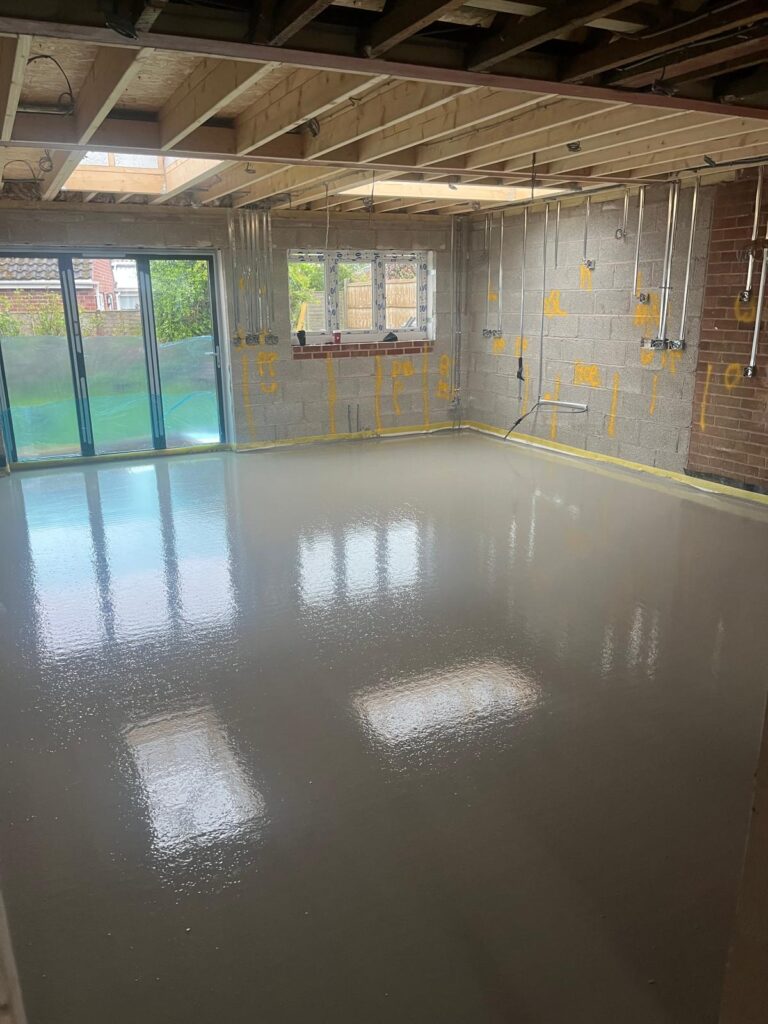

Nationwide Coverage
We have successfully installed a wide range of concrete and screed floors in domestic and commercial properties nationwide, from a single-room extension to complete warehouses.
No screed or concrete flooring assignment is too large or small. No matter your location, you can trust Midland Flooring to deliver high-quality, affordable flooring solutions.
For more information, visit our website contact page and choose the most convenient way to reach us. We value your time and interest and offer a FREE, no-obligation quotation. We believe in providing transparent and fair pricing, reflecting our commitment to your satisfaction, and respecting your decision-making process.
Contact us: call our team on 01675 465 110 or send an email to info@midlandflooring.co.uk
