

Liquid Flow Floor Screed for Underfloor Heating
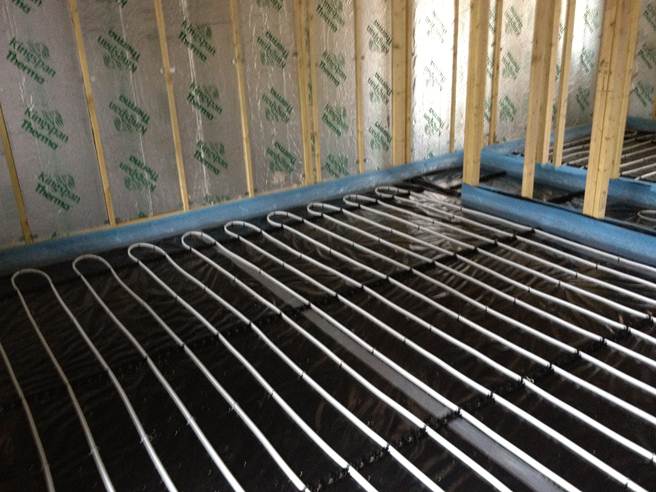
Both anhydrite and cementitious forms of liquid or flowing screeds, as they are commonly referred to, can be used to encapsulate underfloor heating pipes within an underfloor heating system. Some of the advantages of using a flowing or liquid screed with underfloor heating systems are:
- Higher thermal transfer of heat compared with traditional screeds, up to 2.5W. This is partly achieved because the flowing or liquid screed can wrap around the underfloor heating pipes, resulting in a greater surface area in contact with the screed.
- With advancements in screed technology, lower screed depths can be achieved from as thin as 20mm using high-strength products such as TS15 liquid flowing screed. Traditional screeds are usually installed at 75mm depths with underfloor heating. The thinner screed provides a faster response time when initiating the underfloor heating than the 75mm sand and cement screed.
- Liquid or flowing screeds are pumped into the property. This method reduces the risk of damaging underfloor heating pipework, a recurring issue when wheelbarrows were used to deliver sand and cement screeds.
- Foot traffic within 48 hours of installation.
- Loading within seven days from installation.
- Quality BS EN 8204:7:2003
- When the building temperature is maintained at 20 Degrees centigrade, based on a 50mm depth of screed, the floor will reach 60% RH in 28 days or sooner.
- If required, the floor screed can be force-dried after seven days to reduce programme times before the floor finishes are installed.
- Here at Midland Flooring, we can supply and install the insulation membranes, underfloor heating, and liquid-flowing screed using our highly qualified, experienced in-house installer teams, enabling us to guarantee the quality of our work.
Post Installation
Any surface skin should be removed before the heating system is commissioned.
The underfloor heating should be commissioned and run by the following:
Once the screed is at least seven days old
- Switch on the heating system to run at a flow temperature of 25◦C and leave for three days
- Increase the flow temperature in 5◦C increments per day up to a maximum of 55◦C. Leave at this temperature for a minimum of 3 days (typically Seven days if force drying)
- Reduce the flow temperature by 5◦C per day down to 25◦C before switching off and allowing to cool (typically for 48hours) before moisture testing
Test the screed for residual moisture using an approved test method
Once dry, protect the screed from moisture ingress before applying suitable floor coverings
Bonded floor coverings should be applied using a suitably flexible and thermally stable adhesive according to the manufacturer’s instructions.






Nationwide Coverage
We have successfully installed a wide range of concrete and screed floors in domestic and commercial properties nationwide, from a single-room extension to complete warehouses.
No screed or concrete flooring assignment is too large or small. No matter your location, you can trust Midland Flooring to deliver high-quality, affordable flooring solutions.
For more information, visit our website contact page and choose the most convenient way to reach us. We value your time and interest and offer a FREE, no-obligation quotation. We believe in providing transparent and fair pricing, reflecting our commitment to your satisfaction, and respecting your decision-making process.
Contact us: call our team on 01675 465 110 or send an email to info@midlandflooring.co.uk
